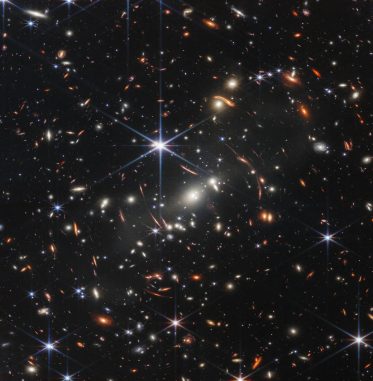
At an event held at the White House on Monday 11 July 2022, US President Joe Biden and
US Vice President Kamala Harris presented for the first time a scientific image taken by
James Webb Space Telescope (JWST). ‘It’s hard to even imagine’, said President Biden.
‘It is amazing. It’s a historic moment for science and technology, for America and for all of
humanity’.
The Project
The James Webb telescope is considered the most powerful yet built and made an impressive debut with
the release of its first scientific image of deep space from its first time observing the universe.
Its construction had begun in 1996 as a NASA project in collaboration with space agencies such as
the European and Canadian Space Agency, with its launch taking place as late as December 25 2021
after occasional postponements. The cost of this project is 10 billion US dollars and its equipment
includes a system of lenses, filters and prisms to detect signals in the infrared spectrum (invisible
to the human eye) at very long distances. This is the largest project in recent years and is, therefore,
named in honour of NASA’s second director, James Webb, who, as is recalled, played a central role in
Project Apollo. According to NASA’s own statements, it even managed to provide the deepest
and clearest infrared image of the distant universe to date. This image, called ‘Webb’s first deep field’,
offers a glimpse into the distant past, millions of years after the Big Bang, showing some of the oldest
lights in the universe. It is an intricate and detailed look at a cluster of galaxies in the field of view,
with GLASS- z13 thought to have formed around 300-400 million years after the Big Bang, based on
estimates of the information gleaned in the first week of observations, whereas with the data today
the estimate has been pulled back a few million years, to just 200 million years after the Big Bang,
making it perhaps the oldest known galaxy so far, followed by GN-z11, 420 million years after
the Big Bang. It is worth noting, however, that nothing is a given, as the results of studies to follow,
such as spectroscopic analyses, etc., are awaited. The Webb Telescope’s attention was also drawn to
the most distant star, called Earendel, a name inspired by a character in the ‘Lord of the Rings’
and to a wheel-shaped galaxy called Cartwheel, probably caused by a recent supernova explosion
during its collision with another galaxy.
The Equipment
The James Webb Telescope ‘s deep field was created from images at various wavelengths, from the
far-infrared (orange-red) to the near-to mid-infrared spectrum, taken using Webb’s near-infrared
camera (NIRCam). In addition to the near-infrared camera (NIRCam), it is also equipped with a
mid-infrared instrument (MIRI), a near-infrared spectrograph (NIRSpec) and a near-infrared imager
and slitless spectrograph (NIRISS), tools used to obtain spectra, data that reveal the physical
and chemical properties of objects, which will allow researchers to identify many more details
about distant galaxies. It took twelve and a half hours to complete, much faster than the
Hubble Space Telescope (for which took whole weeks). It also achieved depths at infrared
wavelengths beyond the deepest fields of the James Hubble Telescope, its predecessor,
and any other prior space or ground-based measuring instrument.
The construction
Because of a mirror that has 6.25 times the surface area of its predecessor, the James Webb Space Telescope is
considered a hundred times more powerful.With the help of solar panels, mirrors, it maintains a stable
temperature as long as it makes observations in ultraviolet radiation, in the faint infrared signals
of very long distances protected by light sources with mirrors. It is particularly interesting that
the two sides of the telescope have a large temperature difference – On the side
exposed to the Sun you could boil water, while on the dark side you could freeze nitrogen!
The ‘bright’ side consists of five layers of solar shields that receive solar energy and power the telescope,
while the ‘dark’ side is a hexagonal light collector with beryllium mirrors, consisting of 18 smaller
hexagons. The telescope eventually operates at about 225 degrees Celsius below zero by
calibrating the temperature of both sides!
The L2 position
It primarily makes observations of the sky in the infrared. In this way it is able to penetrate the veils
of cosmic dust that obscure visible light and see objects in the most distant regions of the universe.
For the last six months since its launch, it has been travelling to its current orbital position
(about 1.5 million kilometres from Earth), constantly developing, calibrating and testing its instruments.
It remains at a constant distance from the Earth, moving in the same direction as the Earth and orbiting
around the second Lagrange point (aka L2) to maintain gravitational equilibrium.
In honor
According to experts, this telescope will revolutionize man’s understanding of the universe.
The only certainty so far is that these developments have captured the interest of the whole world,
not just researchers. Until today, a song has so far been released in honour of the James Webb Space Telescope.
Furthermore, a 264-piece puzzle of the famous photograph of the star-forming region in
the Carina Nebula circulates, now known as the ‘Cosmic Cliffs’ (the puzzle is very special
as it is assembled in successive stages, with no predetermined beginning or end).
Research projects
In fact, of the approximately 1200 proposals from researchers for analyses, the committee approved
already 266, using merit-based methods, specific criteria and anonymity, in its first year of operation.
Opportunities for research young researchers recieved, as exemplified by a student who will investigate
nine different Neptune’s Trojan asteroids. This engineering marvel ever produced by human hands
will allow us to see the first galaxies in the universe, the first black holes and to better understand
the workings of solar systems, exoplanets and so on. Commenting on the first photo of the space
telescope posted, Thomas Zurbuken, NASA’s Deputy Administrator and Director of Science Mission
Command, confirms that of the 5% we already know about the universe with the research we have done
so far, we will slowly get to know it better all at once, as there will be material to study for at least
two decades. In his interview, he refered to the pursuit of exploring the universe for conditions
for the development of life, although this is not a scientific priority, rather the search for changes
in the atmosphere of planets similar to those that the Earth went through 3.5 billion years ago.
For even more amazing history-changing moments of technology you can also read these stories about black holes, and major scientific advancments.
If you want more information about NASA and its projects you can visit its official site: https://www.nasa.gov/
Image credit: NASA, ESA, CSA, and STScI
Author: PC-GR
The World of Technology