New discovery about Saturn | Saturn radiation calculated
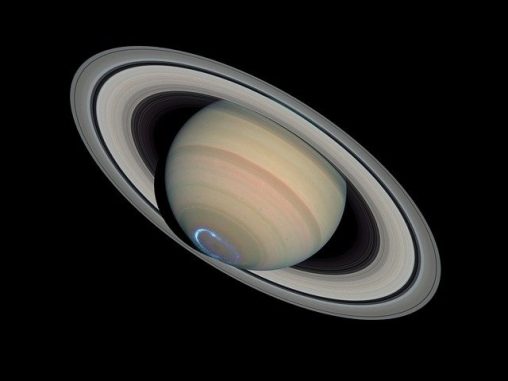
Scientists have discovered a very high-energy proton radiation belt between Saturn and its dense rings. Greek scientists made this discovery while analyzing the final phase of the Cassini spacecraft mission. The new study, led by Professor Stamatis Krimizis, has discovered a new proton radiation band that coexists with the D ring. It is almost completely isolated from the rest of Saturn’s magnetosphere.
The incidence of cosmic rays on the rings create the radiation belt. The protons produced in this way then interacts with Saturn’s atmosphere. The atmosphere includes the faint D ring and its subrings D68 and D73.
On September 15th, Cassini entered Saturn’s atmosphere for a suicide dive in order to end its 13-year research mission. Earlier, the Cassini space probe passed 22 times between Saturn’s rings and the planet’s surface. This region includes the D ring, the innermost and faintest of Saturn’s rings.
When Cassini entered orbit around Saturn in July 2004, the detectors of the MIMI (Magnetospheric Imaging Instrument) science experiment, focused on the region between the planet and the D ring. There was a new opportunity to repeat the measurements after April 2017. This time under improved observational geometry.
“With Cassini coming so close to Saturn, we were able to observe the particles that might have formed the population. MIMI had ‘photographed’ this population in 2004, as well much higher energy particles not remotely measured”. Study leader, Dr Elias Roussos from the Max Planck Institute for Solar System Research in Göttingen, Germany, stated.
Beyond the D ring, there are three rings A, B, and C on Saturn. Seeing them in photographs of Saturn is easy because the rings’ materials are of high-density.
“The enormous efficiency of the A-C rings to absorb charged particles creates a radiation zone that is completely isolated from the rest of Saturn’s volatile magnetosphere,” Dr Konstantinos Dialinas, a partner at the Office of Space Research and Technology and co-author of the paper, told the AP-MEI.
There’s nothing else like it in our solar system. On Earth, the conditions are much more complicated. There is no way to hide from the unpredictably variable influx of high-energy particles from the Sun into our planet’s radiation belts.
MIMI contributed to the discovery of Saturn’s new radiation band, adding to a wealth of Cassini-explored discoveries. The Space Research Technology Office in collaboration with the Hellenic Academy of Athens manage this experiment.
“The MIMI team has published nearly 200 journal and book articles over the past 14 years, 45 of which were led by Greek researchers from the team. These articles are not only about important discoveries about Saturn’s magnetosphere, but also about its moons, its rings and even the heliosphere,” said Professor S. Krimizis, head of the MIMI experiment and co-author of the article. “This is a huge achievement for a multinational team, coordinated by the US but including members from Germany, France, and Greece,” he added.
Gather more information. Continue reading more here.
If you liked this article, then you might also enjoy this one.
Author: PC-GR
The World of Technology