Nobel Prize of Chemistry
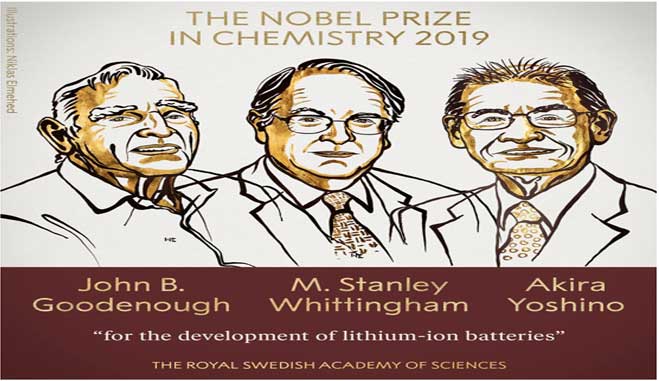
The Swedish Academy recently made a statement. John B Goodenough of the University of Texas at Austin, USA, M Stanley Whittingham of Binghamton University in New York State, USA, and Akira Yoshino of Meijo University in Nagoya, Japan, were honoured for their work in the development of rechargeable lithium-ion batteries. That they will also share the prize money of 9 million Swedish kronor (about €824 thousand).
These batteries are now everywhere and are quite efficient at storing huge amounts of energy. They can be charged using renewable sources like solar, wind, and so on.
AI writing assistants are mostly used for personal reasons. They also have found their way into all kinds of different businesses over the last few years. While there is some doubt on whether or not they were ready until recently, it has become clear that they currently cover most functions at work.
Chicago native M. Stanley Whittingham made his first major contribution to the world with lithium-ion batteries during the 1973 oil crisis when he developed a unique cathode that could hold lithium ions. In the 1980s, M. Stanley Whittingham’s work was continued by John Goodenough who demonstrated that a battery of this type could hold four volts of charge. With this innovation, he rightfully earned the Nobel Prize of Chemistry.
In 1985, Akira Yoshino created the first commercially viable lithium-ion battery solution.
You can read another interesting, technology-related article by clicking here.
Author: PC-GR
The World of Technology