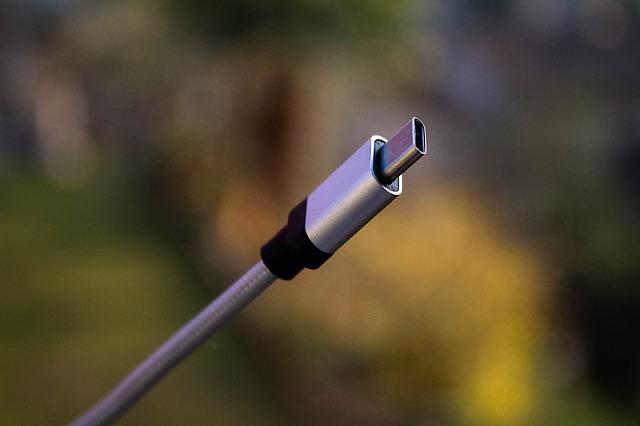
In a press release on Tuesday 7 June 2022, the European Parliament announced the ratification of legislation in the field of technology. The law will provide for the release of smartphones (those sold within the EU) exclusively with the USB-C type port, with the now-called european charger. The aim is to equip phones with a single piece of equipment for wired charging, the european charger, that is common to all.
The Timeline
This project has been in the works for more than a decade, but agreement was only reached yesterday, after consultations between different EU institutions (Parliament and Council). Discussions on this necessary change started in 2009, by which time many manufacturers were already in a mood to align production to this forthcoming legislation. As a result of this, out of 30 different chargers only 3 are left, the USB-C, mini-USB and Apple’s Lightning.
The legislation will take effect 20 days after the summer holidays end on September the 1st. From then on, manufacturers will have 24 months to comply. Their deadline is until the fall of 2024 to parallel with the new rules for the aforementioned devices. In the case of laptops, they will have more time to adapt to the new normality. With a deadline of up to 40 months after the entry into force of the legislation, they have to comply by autumn 2027.
The reason for extending the deadline for laptops is important. It will be difficult to find a standard charger that applies to all laptops of different power requirements. So far a standard cannot cover those computers with a power between 100 and 240 watts.
The Appliances involved
The legislation will also define the same for other electronic appliances. Among these are laptops, e-readers, headphones, keyboards, computer mice. In addition, the list is completed by portable navigation devices, tablets, digital cameras, portable video game consoles and portable speakers. All the above, starting 2024,will acquire the european charger,USB-C.
The Motives
Regarding the goals of this decision, the press release also states that “This law is part of a wider EU effort to make products in the EU more sustainable, reduce e-waste and make life easier for consumers.” Under the new rules, consumers will no longer need a different charger and cable every time they buy a new device and will be able to use the single european charger, USB-C, for all their small and medium-sized portable electronic devices.
European representatives calculate that the environmental burden will be reduced by making supersupply chargers sold with each individual device. Fewer chargers on the market will reduce the amount of e-waste (estimated at 12,000 metric tones) and save at least €250 million in unnecessary charger purchases.
Chargers will be sold separately
Chargers will be sold separately and will not be included in retail boxes with the purchase of a new device. In this way, both the boxes will be smaller and the environmental footprint will be smaller with fewer chargers. And on the consumer side, it will unclutter their drawers, i.e. reduce the chaos of tangled cables, with the purchase of each new device. Estimations say fewer chargers there will be per household regardless of the number of appliances they have.
Apple’s Critique
The tech giant has severely criticized this new legislation. The main reason for its dissatisfaction is the blocking of technological innovation in the face of this standardisation project at the European level at least. On the basis of the statements, it would be impossible to release more innovative versions that are better than the previous ones. The company has even estimated a loss of billions of dollars in revenue by blocking new innovations just for this issue. Regarding the e-waste part, he said that it will be aggravated because it will render the entire Lightning accessory ecosystem useless. About 1 billion iPhones are in use around the world by early 2021, so that’s a lot of charging hardware that will become redundant over time.
The Commission, however, does not acknowledge the potential barriers to the technology’s growth. It anticipates that manufacturers will adopt a standard on which to build. By finding a common standard, manufacturers will now compete with each other on a level playing field.
Changes in Apple
This legislation directly affects the internal market of the whole of Europe. In practice, European legislators are deciding standards for the rest of the world. How could Apple reconcile itself with the global market? As the legislation defines standardisation in wired charging, would it only release products with wireless charging docking stations (see MagSafe)? Would Apple manufacture iPhones with USB-C type exclusively for the European market? This scenario seems a bit unlikely, considering the efficiency of the supply chain.
By September 2024, the company has to modify or completely withdraw older models that do not use the intended port. It is, after all, stipulated by law that no products that do not comply with the regulations will be marketed at all.
Based on reports, even products launched in 2023 could still bear the prescribed changes. The iPhone 14 may not have the intended USB-C type port, but the iPhone 15 and iPhone 16 will carry the european charger.
USB-C vs Lightning
Indeed, USB-C is a collaborative venture, used by major tech players such as Microsoft or HP. And the Lightning ports are used exclusively by Apple. It makes sense that the company wants to keep exclusivity and resist the standardization of USB ports. Apple’s potentially affected profits do not interest the regulators, other than the welfare of European citizens.
Lightning is an 8-pin connector first released in 2012. It features a 6.7 mm by 1.5 mm connector that the user can insert face up or face down. One negative aspect is the slow data transfer. Data transfer speeds are comparable to USB 2.0 speeds, up to 480Mbps for most cases. It is worth mentioning that USB 3.0, also known as SuperSpeed USB, can achieve speeds of up to 5Gbps. And USB 3.2, provides speeds of up to 20Gbps, while USB 4, up to 40Gbps.
USB-C type is objectively faster not only in transferring data, but also in charging the device. In a direct comparison of USB-C with Qi, USB-A and MagSafe speeds, USB-C charged the iPhone 12 Pro faster with a full battery in one hour and 55 minutes. Another positive aspect is its compatibility with earlier, USB 2.0, DVI, VGA, HDMI. On the negative side, the connector can be more easily damaged rendering the port of the portable device useless.
To Conclude
To sum up, European representatives are celebrating the new legislation, which concludes a decade of discussions. Thierry Breton, EU Internal Market Commissioner recently made statements on the matter. He described the new rules as a victory for consumers and an important step towards reducing e-waste in statements. Users of portable products would make their daily lives much easier by eliminating as well incompatible chargers for different devices. The European charging port law, after all, could have far-reaching implications for portable consumer electronics around the world.
To continue reading, you can visit European Parliament’s press release on the official website, https://www.europarl.europa.eu/news/en/press-room/20220603IPR32196/deal-on-common-charger-reducing-hassle-for-consumers-and-curbing-e-waste.
Alternatively, here are some older posts about the new European law.
Author: PC-GR
The World of Technology