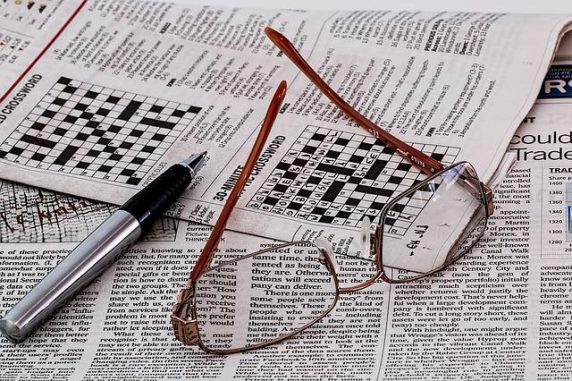
Crossword puzzles have been a brain challenge for at least a century with fanatical solvers. They exploit language skills and create a game of word ambiguity and nuances of language. It is also a particular challenge for artificial intelligence, which challenge was taken up by the University of Siena. In collaboration with Expert.ai they developed WebCrow 2.0, a software that solves crosswords in two languages, Italian and English.
The concept
It all started from questions about the limits and possibilities of artificial intelligence. Could a machine solve a crossword puzzle? How could we compare it to human performance? How could it compare definitions, interpret ambiguities and arrive at correct results? These are just some of the questions Marco Gori asked, a professor in the Department of Computer Engineering and Mathematical Sciences.
Because of the complexity of human language, artificial intelligence is really being tested. It has to have a significant breadth and depth of knowledge to understand the word based on the context in which it is used. It must, also, recognize puns, slang and ambiguities. In addition to the linguistic requirements, solving the crossword obviously demands knowledge of a wide range of topics and areas.
After all, how exciting is it to take artificial intelligence to new levels? A machine being able to understand, to process external stimuli, to think? Maybe to even simulate a human brain, with all the processes it has. This vast wealth of information and knowledge, how could it use it to manage knowledge?
How does it work?
This artificial intelligence software uses natural language processing technology (NLP) to understand the clues of a puzzle, just as a gamer would. It is the richest online repository of knowledge worldwide and can also use other expert modules with Redis messaging channels. It revolves a distributed intelligence that generates the list of candidate answers for each item in the crossword puzzle.
In summary
It first starts by understanding the clues. With various technology tools it collects the different pieces of information. Some of these tools are ontologies, knowledge graphs and self-referenced material from the web. With a sequence of logical and linguistic steps the software tries out possible combinations of words. The lists of candidate words are scored and merged for each item. With a constraint satisfaction algorithm the correct words are placed in the correct positions.
AI technology
Advances in technology have shown that AI can -already- beat humans in games such as chess, backgammon or checkers. Now the language game of crossword puzzles will highlight its weaknesses as well as its strengths.
However, we must bear in mind that in just the last 10 years artificial intelligence has made great technological strides. For this project in particular, an initial core of technology was available at the start of its construction in 2004. This concerns search engines, information retrieval techniques and machine learning.
NLP Module
NLP Module and the Web Search Module (WSM) play a preliminary role. The NLP technology is a recent innovation of Expert.ai and is used together with knowledge graphs and deep language analysis.
Modules are being developed that use word embedding. Words belonging to text sources are vectors of real numbers. Each vector represents word meaning and thus those with similar content occupy nearby positions. Modules who utilize word embedding go beyond strict word meaning and thus seek broader correspondences with word vectors. This approach is also effective for dealing with the multicolour of language, words with multiple meanings, etc. In this way, answers to the crossword puzzles are found by utilizing data collected.
Web Search Module
The Web Search Module is the heart of WebCrow 2.0. It leverages the web with search engines for all queries expressed in natural language (NL). Obviously, by the nature of the crossword, the process is more demanding. A notable advantage is that the solver knows the number of letters of a word and the search becomes easier with this component.
The architecture of the module is based on three submodules.
- A web-based list generator. This extracts possible answers by selecting the terms with the correct range. This is also where compound words are selected
- A statistical filter to rank the candidate words utilizing information retrieval techniques
- A filter to rank the words according to NLP
The Web Search Module demonstrates very good performance in finding answers. So far it has high levels of accuracy and coverage of the system.
Merge list of candidate words
No expert can alone provide all the answers correctly in the crossword puzzle. Merging from the candidate word lists for the fields is essential. However, with only a superficial merge the system couldn’t complete the grid correctly.
Completing the grid
The crossword puzzle is solved like a Probabilistis-CSP problem. The software acquires the lists of candidate words and their corresponding puzzle positions. The mathematical system exploits the maximum likelihood function.
The predecessor
Last year there was an artificial intelligence called Dr. Fill. The software outperformed the majority of the best human competitors in an American Crossword Puzzle Tournament. However, it was not infallible, of course, as it scored three mistakes in that tournament.
The upcoming event
How exciting is it to have humans and software working together to take artificial intelligence to a new level? The software, indeed, will soon be put to the test. The founding University of Siena together with Expert.ai are organising a big event. This will take place in Padua between 18 and 23 July in collaboration also with Sprea Edizioni and AVCX. They develop crossword puzzles in English and Italian, ‘not for the faint-hearted’, as they state. At this event we will see, in these preliminary stages, who will win. The man or the machine? Who will you support?
This multi-day event will also include the international ‘Computational Intelligence’ Conference (WCCI 2022) to discuss the future of WebCrow 2.0. Other topics discussed by the conference participants are the evolution of crosswords as well as the cognitive capabilities of these software agents.
The evolution of WebCrow 2.0
Based on statements, in future plans WebCrow 2.0 will be expand in other European languages such as French, German or Spanish. In fact, there is an ambition for the software to create its own crossword puzzle! Presumably, it will be possible to generate crosswords thematically, from any domain.
Join the challenge
If you think you can compete with the AI in this unique experience, try solving a crossword yourself. Enter the arena of this exciting brain challenge by registering in,
https://arena.pragma.software/
Here are some other areas, that Artificial Technology reaches.
Author: PC-GR
The World of Technology