First moon ride with Roving Vehicle (RV) | Apollo 15 mission’s RV drive | Techday, July 31st
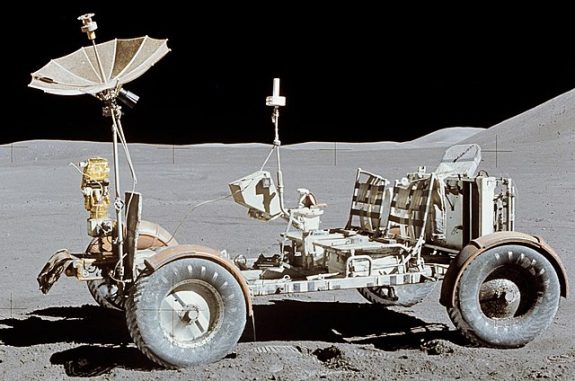
On this TECHDAY in history, on July 31st 1971, humans drove a vehicle for the first time on the moon. That happened using the Lunar Roving Vehicle (LRV), a battery-powered vehicle that was part of the Apollo 15 mission. The one driving it was astronaut David Scott. Astronauts of previous missions had a much more limited range, because their heavy life-supporting equipment prevented them from walking too far. During the Apollo 15, 16 and 17 missions three LRVs were used. They all still remain on the moon’s surface.
Astronauts David Scott and James Irwin used the LRV to explore the Hadley-Apennine region of the Moon. They drove the LRV a total of 27.9 km (17.3 mi) and conducted three EVAs (extra-vehicular activities) outside the LM, during which they collected samples, conducted experiments, and took photographs.
The LRV proved to be an invaluable tool for the astronauts as it greatly increased their range and allowed them to explore areas that would have been otherwise inaccessible. It also allowed them to collect a greater variety and amount of samples than previous missions. The LRV was used on the Apollo 15, 16, and 17 missions and greatly expanded our understanding of the lunar surface.
This was just a snapshot on the presentation of the techday series. Gather more information on the first moon ride. Indulge into the history by further reading more.
Alternatively, find more technology stories. If you found this brief post interesting, then you might also enjoy these ones as well.
Author: PC-GR
The World of Technology