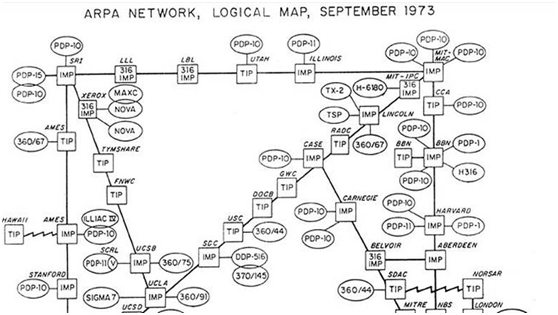
The Internet only started to grow in size about fifteen years ago, becoming a vast ocean of information that carries data across the world. Before that, using the internet was much more simplistic. ARPANET was the first packet-switching network that later became what we know as the Internet. Half a century ago, this entire network consisted of just 45 computers connected to 40 nodes.
A map from 1973 indicates that there were 42 hosts connecting to 36 nodes in the US. The map basically shows what the internet looked like in September 1973. The Defense Advanced Research Projects Agency drew and published it in January 1974 as part of a report about the ARPAnet. The pioneers of what we know today as the Internet originated from technology departments at MIT, Harvard, UCLA, Xerox, and NASA’s Ames Research Center.
The square markers represent the gateways when the nodes are displayed on a map like this. These were essentially the routers. The ovals represent the hosts, which were essentially central computer units connected to these gateways.
Norway was the first country outside the US to connect to the Internet. The project team was extremely confident that their design would work. On September 18th, 1973, at 9:29 pm (UTC), more than a million miles of wire and fiber cable leading out of Norway started carrying bits across the Earth.
Read more articles like this here or here.
Author: PC-GR
The World of Technology